×
Request Free Sample ×

Kindly complete the form below to receive a free sample of this Report

Leading companies partner with us for data-driven Insights

clients tt-cursor
Hero Background

It Staffing Market

ID: MRFR/ICT/22564-HCR
100 Pages
Aarti Dhapte
October 2025

IT Staffing Market Research Report By IT Skill Sets (Cloud Computing, Artificial Intelligence (AI) and Machine Learning (ML), Cybersecurity, Database Management, Software Development), By Contract Type (Temporary Staffing, Contract-to-Hire, Direct Placement), By Industry Verticals (Financial Services, Healthcare, Technology, Manufacturing, Retail), By Job Level (Entry-Level, Mid-Level, Senior-Level), By Deployment Model (On-Premise, Cloud-Based, Hybrid) - Forecast to 2035

Share:
Download PDF ×

We do not share your information with anyone. However, we may send you emails based on your report interest from time to time. You may contact us at any time to opt-out.

It Staffing Market Infographic
Purchase Options

It Staffing Market Summary

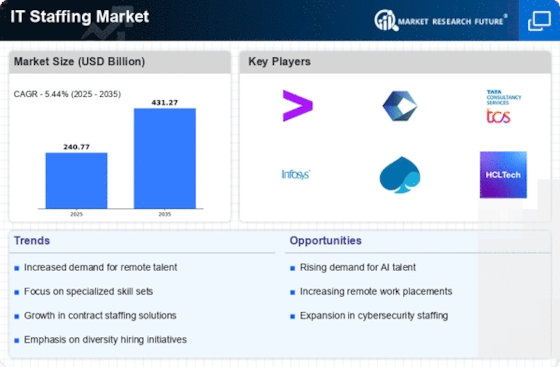
As per MRFR analysis, the IT Staffing Market Size was estimated at 240.77 USD Billion in 2024. The IT Staffing industry is projected to grow from 253.87 USD Billion in 2025 to 431.27 USD Billion by 2035, exhibiting a compound annual growth rate (CAGR) of 5.44 during the forecast period 2025 - 2035.

Key Market Trends & Highlights

The IT Staffing Market is experiencing a dynamic shift towards specialized skills and remote work solutions.

  • The demand for specialized IT skills continues to rise, particularly in North America, which remains the largest market.
  • Remote work has become a central focus, influencing staffing strategies across the Asia-Pacific region, the fastest-growing market.
  • Advanced recruitment technologies are increasingly integrated into staffing processes, enhancing efficiency and candidate matching.
  • The growing need for IT talent and the rise of remote work opportunities are driving market expansion, particularly in the Cloud Computing and Contract-to-Hire segments.

Market Size & Forecast

2024 Market Size 240.77 (USD Billion)
2035 Market Size 431.27 (USD Billion)
CAGR (2025 - 2035) 5.44%

Major Players

Accenture (US), Cognizant (US), TCS (IN), Infosys (IN), Capgemini (FR), HCL Technologies (IN), Wipro (IN), Randstad (NL), Robert Half (US), Kforce (US)

It Staffing Market Trends

The IT Staffing Market is currently experiencing a dynamic evolution, driven by the increasing demand for specialized technology skills across various sectors. Organizations are recognizing the necessity of agile staffing solutions to remain competitive in a rapidly changing digital landscape. This market is characterized by a growing reliance on both permanent and contract staffing arrangements, as companies seek to optimize their workforce while managing costs effectively. The rise of remote work has further transformed traditional staffing models, allowing firms to tap into a broader talent pool, transcending geographical limitations. As a result, the IT Staffing Market is becoming more diverse and inclusive, with an emphasis on attracting talent from various backgrounds and experiences. Moreover, the integration of advanced technologies such as artificial intelligence and machine learning into recruitment processes is reshaping how staffing firms operate. These innovations facilitate more efficient candidate sourcing and matching, enhancing the overall hiring experience for both employers and job seekers. The IT Staffing Market appears poised for continued growth, as organizations increasingly prioritize flexibility and adaptability in their workforce strategies. This trend suggests a shift towards a more collaborative approach between staffing agencies and businesses, fostering long-term partnerships that can better address evolving workforce needs.

Increased Demand for Specialized Skills

The IT Staffing Market is witnessing a heightened need for professionals with niche technical expertise. As technology evolves, companies are seeking individuals who possess specific skills that align with their strategic objectives. This trend indicates a shift towards more tailored staffing solutions, where agencies focus on sourcing candidates with specialized knowledge.

Emphasis on Remote Work

The rise of remote work has significantly influenced the IT Staffing Market. Organizations are now more open to hiring talent from diverse geographical locations, which broadens the candidate pool. This shift not only enhances flexibility but also allows companies to access a wider range of skills and experiences.

Integration of Advanced Recruitment Technologies

The incorporation of advanced technologies in recruitment processes is transforming the IT Staffing Market. Tools such as artificial intelligence and machine learning are streamlining candidate sourcing and matching, leading to more efficient hiring practices. This trend suggests that staffing agencies are increasingly leveraging technology to improve their services.

It Staffing Market Drivers

Growing Need for IT Talent

The IT Staffing Market is currently experiencing a pronounced increase in demand for skilled IT professionals. As organizations continue to digitize their operations, the need for specialized talent in areas such as cybersecurity, data analytics, and cloud computing has surged. According to recent data, the demand for IT roles is projected to grow by 22% over the next decade, significantly outpacing the average growth rate for all occupations. This trend indicates that companies are increasingly reliant on external staffing solutions to fill critical positions, thereby driving growth in the IT Staffing Market. The competition for qualified candidates is intensifying, compelling staffing firms to innovate their recruitment strategies to attract top talent.

Focus on Diversity and Inclusion

The IT Staffing Market is increasingly prioritizing diversity and inclusion in hiring practices. Organizations are recognizing the value of diverse teams in driving innovation and improving problem-solving capabilities. As a result, there is a growing emphasis on sourcing candidates from varied backgrounds, which is reshaping recruitment strategies within the IT Staffing Market. Data indicates that companies with diverse workforces are 35% more likely to outperform their competitors. Staffing agencies are adapting to this trend by implementing inclusive hiring practices and promoting diversity initiatives, thereby enhancing their appeal to clients. This focus on diversity is expected to continue influencing the IT Staffing Market, as organizations strive to create more equitable workplaces.

Rise of Remote Work Opportunities

The IT Staffing Market is significantly influenced by the rise of remote work opportunities. As companies adapt to flexible work arrangements, the geographical limitations on talent acquisition have diminished. This shift allows organizations to tap into a broader talent pool, enabling them to find specialized IT professionals regardless of their location. Data suggests that remote work has become a preferred option for many IT professionals, with over 70% expressing a desire for flexible work arrangements. Consequently, staffing firms are adapting their strategies to cater to this demand, offering remote staffing solutions that align with the evolving preferences of both employers and employees. This trend is likely to continue shaping the IT Staffing Market in the foreseeable future.

Increased Investment in IT Infrastructure

The IT Staffing Market is benefiting from increased investment in IT infrastructure across various sectors. Organizations are recognizing the necessity of robust IT systems to support their operations and enhance competitiveness. This investment trend is reflected in the projected growth of IT spending, which is expected to reach trillions of dollars in the coming years. As companies expand their IT capabilities, the demand for skilled professionals to implement and manage these systems rises correspondingly. Staffing firms are thus positioned to play a crucial role in fulfilling this demand, providing organizations with the necessary talent to navigate their IT infrastructure projects. This dynamic is likely to sustain growth within the IT Staffing Market.

Technological Advancements in Recruitment

The IT Staffing Market is witnessing a transformation due to the integration of advanced recruitment technologies. Tools such as artificial intelligence and machine learning are being utilized to streamline the hiring process, enhancing efficiency and accuracy in candidate selection. These technologies enable staffing agencies to analyze vast amounts of data, identify suitable candidates more quickly, and reduce time-to-hire metrics. As a result, organizations are increasingly turning to IT staffing firms that leverage these innovations, thereby propelling growth in the market. Furthermore, the adoption of applicant tracking systems and automated interview scheduling is becoming commonplace, indicating a shift towards more tech-driven recruitment practices within the IT Staffing Market.


Market Segment Insights

By IT Skill Sets: Cloud Computing (Largest) vs. Artificial Intelligence (Fastest-Growing)

In the IT Staffing Market, Cloud Computing holds a significant share, underscoring its dominance in various sectors looking for flexible and scalable solutions. Companies are increasingly prioritizing cloud skills among potential recruits as the shift to digital infrastructures accelerates. On the other hand, Artificial Intelligence (AI) and Machine Learning (ML) skills are rapidly gaining traction, as organizations seek to leverage these technologies to drive innovation and efficiency. This competitive landscape reveals a clear preference for professionals skilled in these areas, shaping hiring strategies in IT staffing.

Cloud Computing: Dominant vs. Artificial Intelligence: Emerging

Cloud Computing has established itself as the dominant skill set in IT staffing, with organizations consistently seeking talent experienced in platforms such as AWS, Azure, and Google Cloud. This segment thrives on the demand for remote services and solutions, reflecting a broader trend towards digital transformation. Conversely, Artificial Intelligence, while still emerging, is recognized as the fastest-growing skill set. Companies are investing heavily in AI talent to enhance their capabilities in data analytics, automation, and customer engagement, creating a dynamic interplay between these two critical skill sets in the IT staffing landscape.

By Contract Type: Temporary Staffing (Largest) vs. Contract-to-Hire (Fastest-Growing)

In the IT Staffing Market, the segment distribution among contract types reveals Temporary Staffing as the dominant force, making up a significant portion of the market share. Organizations favor temporary staffing solutions for their flexibility, allowing them to quickly adapt to changing project demands and resource requirements. The Contract-to-Hire segment is gaining traction, as it offers a pathway for employers to assess a candidate's fit before making a long-term commitment, thereby leading to a gradual shift in market dynamics.

Temporary Staffing (Dominant) vs. Contract-to-Hire (Emerging)

Temporary Staffing remains the dominant segment in the IT staffing landscape, characterized by its contributions to flexibility and responsiveness. Companies leverage temporary staffing to fulfill immediate project needs without the commitment of permanent hires. Conversely, Contract-to-Hire is emerging as a preferred option among organizations aiming for a hybrid solution. This model allows companies to evaluate potential talent before committing to a full-time position, thus reducing hiring risks. As businesses focus on refining their talent acquisition strategies, both segments will continue to play crucial roles, with temporary staffing maintaining its stronghold, while Contract-to-Hire attracts attention for its strategic advantages.

By Industry Verticals: Financial Services (Largest) vs. Healthcare (Fastest-Growing)

The IT Staffing Market exhibits a varied distribution among different industry verticals. Financial Services holds the largest share due to its continuous demand for skilled IT professionals to manage complex systems and data security. Healthcare, on the other hand, is rapidly increasing its reliance on technology, leading to a significant uptick in IT staffing requirements. The other sectors, including Technology, Manufacturing, and Retail, also contribute to the growth but are overshadowed by the dominance of these two verticals. The growth trends within these segments are driven by ongoing digital transformations and a shift towards automation. Financial Services continues to invest in technology to enhance customer experience and ensure compliance, prompting a sustained need for IT staffing. Meanwhile, Healthcare's adoption of telemedicine and electronic health records fuels its rapid growth, as organizations seek to leverage technology for improved patient care and operational efficiency. This trend is expected to continue as both sectors evolve to embrace newer technologies.

Financial Services: Dominant vs. Healthcare: Emerging

Financial Services remains the dominant vertical in the IT Staffing Market, primarily due to its extensive and complex needs in IT infrastructure and cybersecurity. Organizations in this sector are proactively seeking professionals skilled in specialized areas such as blockchain, data analytics, and AI to stay competitive. In contrast, Healthcare is emerging as a rapidly growing segment due to its increased adoption of technology solutions for patient management and administrative efficiency. IT staffing in Healthcare is focused on providing professionals adept at navigating the intricate regulatory landscape, implementing telehealth solutions, and enhancing data security. Both verticals present unique challenges and opportunities, influencing the competitive dynamics within the IT staffing landscape.

By Job Level: Entry-Level (Largest) vs. Senior-Level (Fastest-Growing)

In the IT Staffing Market, the distribution among job levels reveals that Entry-Level positions currently hold the largest market share. This segment encompasses a wide range of positions suited for recent graduates and those new to the IT field. As a critical entry point into the industry, these jobs cater to companies aiming to build a skilled workforce while keeping labor costs manageable. Mid-Level roles follow closely, encompassing a vital bridge between the foundational skills learned at the Entry-Level and the advanced expertise required at the Senior-Level. Growth trends indicate that Senior-Level positions are the fastest-growing segment of the IT staffing market due to increasing demand for experienced professionals capable of taking on complex projects and leadership roles. Companies are prioritizing talent acquisition at this level to drive innovation and strategic initiatives. Factors driving demand in this sector include digital transformation and the need for strategic IT leadership in navigating technical advancements. The dynamic nature of IT also continues to increase competition for qualified Senior-Level talents, ensuring sustained growth in this segment.

Entry-Level (Dominant) vs. Senior-Level (Emerging)

Entry-Level positions in the IT Staffing Market represent a dominant force, primarily filled by candidates with foundational technical skills and potential for growth. These roles are designed to attract new talent into the industry, often characterized by positions in help desk support, system administration, and junior developer roles. These jobs not only provide essential experience for newcomers but also serve as a recruitment strategy for companies hoping to cultivate talent from the ground up. Meanwhile, Senior-Level roles are emerging as a critical area of focus due to the rising complexities of IT projects. These positions require significant expertise and experience, with a strong understanding of both technology and business strategy. Employers seek Senior-Level professionals who can guide teams, drive projects to success, and innovate within their organizations.

By Deployment Model: On-Premise (Largest) vs. Cloud-Based (Fastest-Growing)

In the IT Staffing Market, the deployment model segment is segmented mainly into three categories: On-Premise, Cloud-Based, and Hybrid. On-Premise staffing remains the largest segment due to its established presence and traditional preference among businesses that prioritize data security and control. Meanwhile, Cloud-Based staffing solutions are experiencing rapid growth as firms increasingly seek flexibility, scalability, and cost-effectiveness, making it a significant player in the segment.

On-Premise (Dominant) vs. Cloud-Based (Emerging)

On-Premise staffing solutions continue to dominate the IT Staffing Market as they offer organizations greater control over their IT infrastructure and compliance with various regulatory requirements. These solutions are often favored by industries that deal with sensitive information and legacy systems. Conversely, Cloud-Based staffing is emerging as a viable alternative, appealing to companies that embrace remote work and agile methodologies. With the rise of digital transformation initiatives, Cloud-Based staffing is capitalizing on its ability to provide streamlined access to a diverse talent pool while minimizing overhead costs. This shift reflects broader trends in workforce flexibility and the increasing reliance on technology-driven solutions.

Get more detailed insights about It Staffing Market

Regional Insights

North America : Tech Innovation Leader

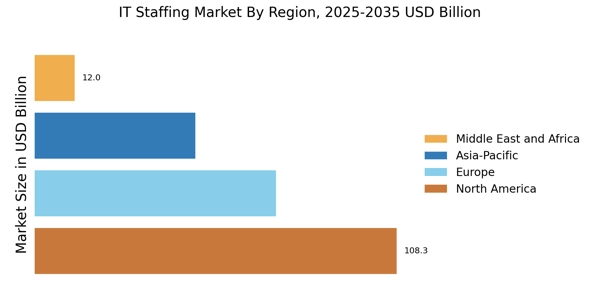
North America remains the largest market for IT staffing, holding approximately 45% of the global share. The region's growth is driven by rapid technological advancements, increasing demand for IT services, and a robust regulatory environment that supports innovation. The U.S. and Canada are the primary contributors, with a strong focus on digital transformation and cloud computing, further fueling market expansion. The competitive landscape is characterized by major players such as Accenture, Cognizant, and Robert Half, which dominate the market. The presence of these key players, along with a growing number of startups, enhances the region's attractiveness for IT staffing. The demand for skilled IT professionals continues to rise, driven by sectors like finance, healthcare, and technology, ensuring a vibrant market for staffing services.

Europe : Emerging IT Staffing Hub

Europe is witnessing significant growth in the IT staffing market, accounting for approximately 30% of the global share. The region's expansion is fueled by increasing digitalization across various sectors, regulatory support for tech innovation, and a growing emphasis on cybersecurity. Countries like Germany and the UK are leading this growth, driven by their strong economies and investment in technology. The competitive landscape features key players such as Capgemini and Randstad, alongside numerous local firms. The demand for IT staffing is particularly strong in Germany, where the government is actively promoting digital skills development. This focus on enhancing workforce capabilities is expected to further boost the market, making Europe a vital player in the global IT staffing arena.

Asia-Pacific : Rapidly Growing Market

Asia-Pacific is emerging as a powerhouse in the IT staffing market, holding around 20% of the global share. The region's growth is driven by rapid urbanization, increasing internet penetration, and a burgeoning tech startup ecosystem. Countries like India and China are at the forefront, with India being the second-largest market, benefiting from a vast pool of IT talent and favorable government policies promoting technology adoption. The competitive landscape is marked by the presence of major players like TCS, Infosys, and HCL Technologies, which dominate the market. The demand for IT staffing is particularly high in sectors such as e-commerce, fintech, and healthcare. As companies increasingly seek specialized IT skills, the region is poised for continued growth, making it a critical area for staffing services.

Middle East and Africa : Emerging Market Potential

The Middle East and Africa region is gradually emerging in the IT staffing market, accounting for about 5% of the global share. The growth is driven by increasing investments in technology infrastructure, government initiatives to promote digital economies, and a rising demand for skilled IT professionals. Countries like South Africa and the UAE are leading this growth, focusing on enhancing their tech capabilities to attract foreign investment. The competitive landscape is evolving, with local firms and international players like Wipro and Cognizant expanding their presence. The demand for IT staffing is particularly strong in sectors such as telecommunications and finance, where digital transformation is a priority. As the region continues to develop its tech ecosystem, the potential for IT staffing services is expected to grow significantly.

It Staffing Market Regional Image

Key Players and Competitive Insights

Major players in It Staffing Market are constantly striving to gain a competitive edge in the industry. They are adopting innovative strategies such as expanding their service offerings, investing in technology, and forming strategic partnerships. Leading It Staffing Market players are also focusing on improving their global reach and strengthening their relationships with clients. The It Staffing Market industry is highly competitive, with several established and emerging players vying for market share. One of the leading companies in the It Staffing Market is Robert Half International. The company provides a range of staffing services, including temporary, permanent, and contract staffing.

Robert Half International has a strong global presence and operates in over 30 countries. The company has a reputation for providing high-quality staffing solutions and has a strong track record of success.

A notable competitor in the It Staffing Market is Kelly Services. The company offers a comprehensive suite of staffing services, including IT staffing, professional staffing, and workforce management. Kelly Services has a global footprint and operates in over 60 countries. The company has a strong focus on innovation and has invested heavily in technology to improve its service offerings.

Key Companies in the It Staffing Market market include

Industry Developments

Recent developments in the It Staffing Market include the increasing adoption of remote work and the rise of AI-powered staffing platforms. The market is also being driven by the growing demand for skilled IT professionals in various industries. In 2023, the market is valued at approximately USD 216.55 billion and is projected to reach USD 349.0 billion by 2032, exhibiting a CAGR of 5.44%. Key players in the market include Adecco Group, ManpowerGroup, Robert Half International, and Kelly Services.

Future Outlook

It Staffing Market Future Outlook

The IT Staffing Market is projected to grow at a 5.44% CAGR from 2024 to 2035, driven by technological advancements, increasing demand for skilled professionals, and the rise of remote work.

New opportunities lie in:

  • Development of AI-driven recruitment platforms to enhance candidate matching.
  • Expansion into emerging markets with tailored staffing solutions.
  • Creation of specialized training programs to upskill candidates in high-demand technologies.

By 2035, the IT Staffing Market is expected to be robust, reflecting sustained growth and innovation.

Market Segmentation

It Staffing Market Job Level Outlook

  • Entry-Level
  • Mid-Level
  • Senior-Level

It Staffing Market Contract Type Outlook

  • Temporary Staffing
  • Contract-to-Hire
  • Direct Placement

It Staffing Market IT Skill Sets Outlook

  • Cloud Computing
  • Artificial Intelligence (AI) and Machine Learning (ML)
  • Cybersecurity
  • Database Management
  • Software Development

It Staffing Market Deployment Model Outlook

  • On-Premise
  • Cloud-Based
  • Hybrid

It Staffing Market Industry Verticals Outlook

  • Financial Services
  • Healthcare
  • Technology
  • Manufacturing
  • Retail

Report Scope

MARKET SIZE 2024240.77(USD Billion)
MARKET SIZE 2025253.87(USD Billion)
MARKET SIZE 2035431.27(USD Billion)
COMPOUND ANNUAL GROWTH RATE (CAGR)5.44% (2024 - 2035)
REPORT COVERAGERevenue Forecast, Competitive Landscape, Growth Factors, and Trends
BASE YEAR2024
Market Forecast Period2025 - 2035
Historical Data2019 - 2024
Market Forecast UnitsUSD Billion
Key Companies ProfiledMarket analysis in progress
Segments CoveredMarket segmentation analysis in progress
Key Market OpportunitiesGrowing demand for specialized skills in artificial intelligence and cybersecurity within the IT Staffing Market.
Key Market DynamicsRising demand for specialized IT skills drives competitive pressures and influences staffing strategies across various sectors.
Countries CoveredNorth America, Europe, APAC, South America, MEA

Leave a Comment

FAQs

What is the current valuation of the IT Staffing Market in 2025?

The IT Staffing Market is valued at approximately 240.77 USD Billion in 2024.

What is the projected market size for the IT Staffing Market by 2035?

The market is projected to reach around 431.27 USD Billion by 2035.

What is the expected CAGR for the IT Staffing Market during the forecast period 2025 - 2035?

The expected CAGR for the IT Staffing Market during the forecast period 2025 - 2035 is 5.44%.

Which segments are driving growth in the IT Staffing Market?

Key segments driving growth include Cloud Computing, AI and Machine Learning, and Cybersecurity, with valuations ranging from 40.0 to 100.0 USD Billion.

What are the primary contract types in the IT Staffing Market?

The primary contract types include Temporary Staffing, Contract-to-Hire, and Direct Placement, with Temporary Staffing valued at 96.31 USD Billion.

Which industries are the largest consumers of IT staffing services?

The largest consumers include Technology, Financial Services, and Healthcare, with Technology alone valued at 72.31 USD Billion.

What job levels are most in demand within the IT Staffing Market?

Mid-Level and Senior-Level positions are most in demand, with Mid-Level positions valued at 96.46 USD Billion.

How does the deployment model impact the IT Staffing Market?

The deployment model shows a preference for Cloud-Based solutions, projected to reach 180.0 USD Billion by 2035.

Who are the key players in the IT Staffing Market?

Key players include Accenture, Cognizant, TCS, Infosys, and Capgemini, among others.

What trends are expected to shape the IT Staffing Market in the coming years?

Trends likely to shape the market include increased demand for specialized skills in AI, Cybersecurity, and Cloud Computing.

Download Free Sample

Kindly complete the form below to receive a free sample of this Report

Compare Licence

×
Features License Type
Single User Multiuser License Enterprise User
Price $4,950 $5,950 $7,250
Maximum User Access Limit 1 User Upto 10 Users Unrestricted Access Throughout the Organization
Free Customization
Direct Access to Analyst
Deliverable Format
Platform Access
Discount on Next Purchase 10% 15% 15%
Printable Versions